Web3 · Privacy · Element Finance
Element Finance airdrop
A private airdrop made understandable: I turned the randomness a zero-knowledge claim needs into a slider you drag, and the jargon into a Public ID.
- Role
- Design consultant through Advanced Blockchain, an investor in Element
- Scope
- I came up with the idea, then prototyped, presented and designed the claim flow; Tina at Element built the final interface. This was my only work on Element
- When
- Early 2022, for the April 2022 airdrop
- With
- Element's team and a16z, over a handful of calls
- Practice
- Interaction design · Prototyping · User flows
- $200M+deposited in Element at its late-2021 peak
- $32MSeries A raised by Element
The problem
Element Finance was one of DeFi’s larger protocols: more than $200 million was deposited in it at its late-2021 peak, and it had raised a $32 million Series A. In April 2022 it gave governance tokens to the people who had helped build its community, including members of its Discord. The catch: a wallet’s history is public, so a list linking Discord names to wallets would tell the world who owned what.
a16z had designed a way round this. Each person makes two secret numbers, a key and a secret, and posts only a scrambled version of them in Discord. Later they prove, with a zero-knowledge proof, that one of the posted values is theirs, without revealing which one.
That is sound cryptography and a hard thing to ask of people. The brief handed me terms like “commitment”, two steps a week apart, a moment where the user has to supply randomness, and a 10 to 60-second wait while the proof was generated. If someone lost their key and secret, they lost their tokens.
Map it before drawing it
I started with two user stories, one for each step, and drew them as flows that marked what was a page, what the user typed and what ran in the background. Once the flows were clear, so were the mechanism and the screens I had to design.
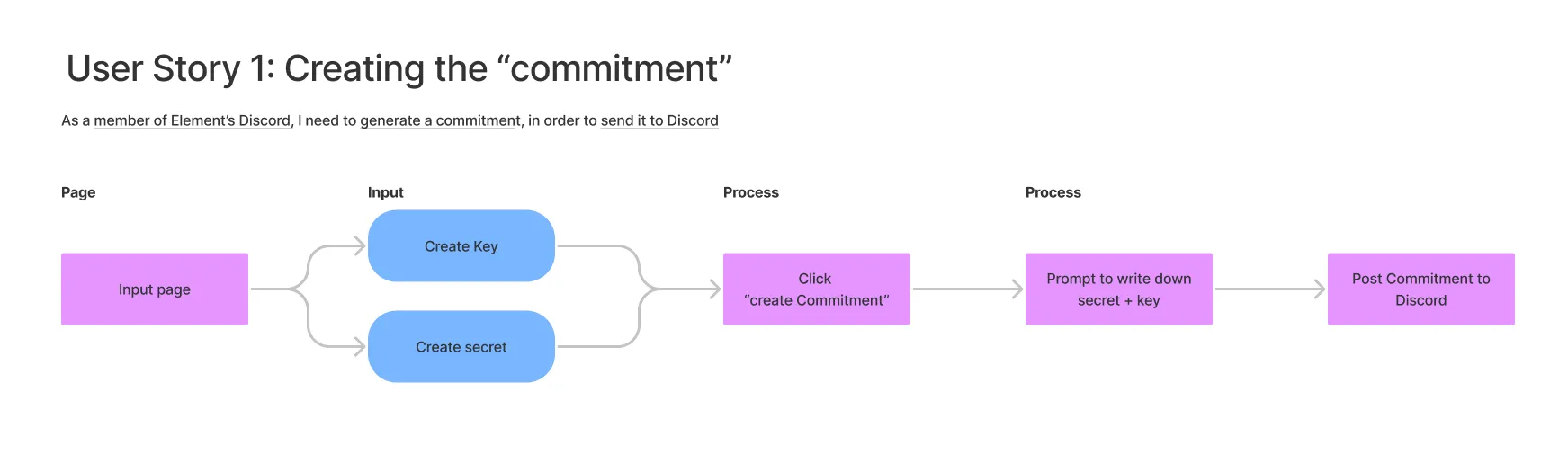
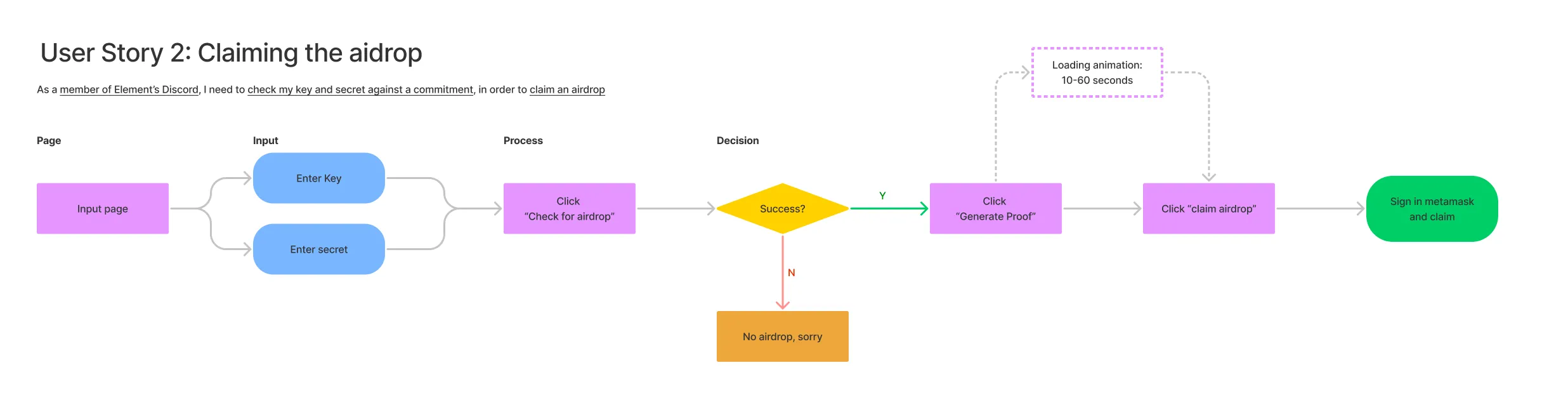
The two flows, with pages, inputs and background processes marked.
Make the randomness a gesture
The brief said the key and secret needed input from the user to be truly random. I wanted a fun way to create that randomness, and a clear one. I found a random number generator driven by mouse movement and combined it with a slider: as you drag, tiny movements of the pointer generate the digits, and reaching the end of the track signals that the step is done.
The randomness is what keeps people anonymous. A Public ID is a fingerprint of the key and secret that cannot be reversed, so posting it in Discord gives nothing away. When you claim, the proof shows you know the key and secret behind one of the posted IDs without saying which. That only holds if nobody else can work out your key and secret: if they could be guessed, someone could recreate your Public ID, match your Discord name to the wallet that claims, or claim your tokens first. The tiny, unrepeatable movements of a hand on a mouse are something nobody else can reproduce.
I prototyped it quickly and showed it to the team.
The first prototype: dragging the slider fills the field with random digits.
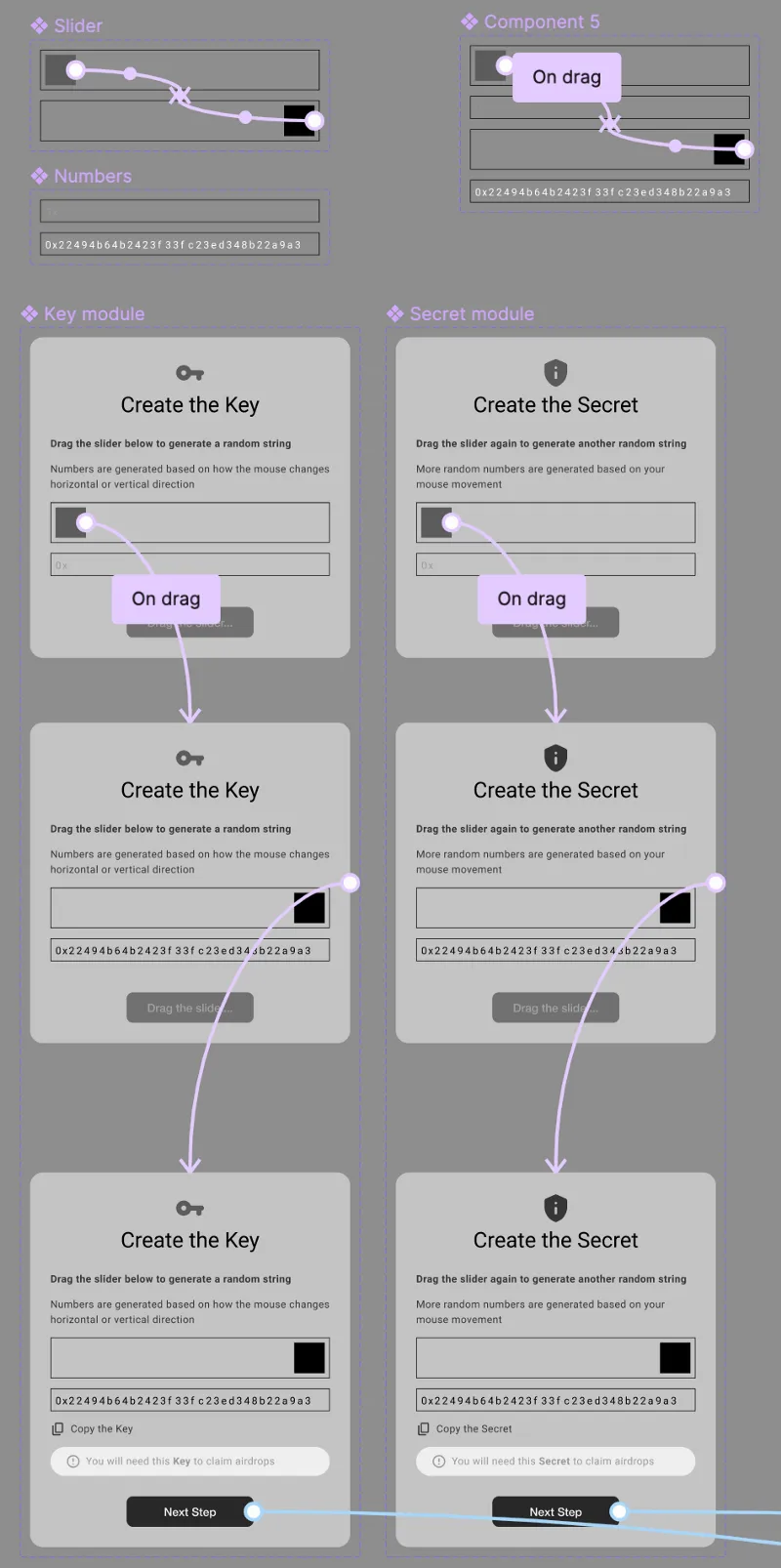
The prototype used Figma’s interactive components rather than a screen for every state. Each digit is a vertical strip of characters clipped to the height of one line; dragging the slider moves every strip to a new position, so the field rolls like a combination lock. Nested start and end variants meant one component carried the whole interaction, and the Next step button only became active once the slider reached the end.
The tumbler effect: strips of characters inside a field with Clip content turned on.
Replace the jargon
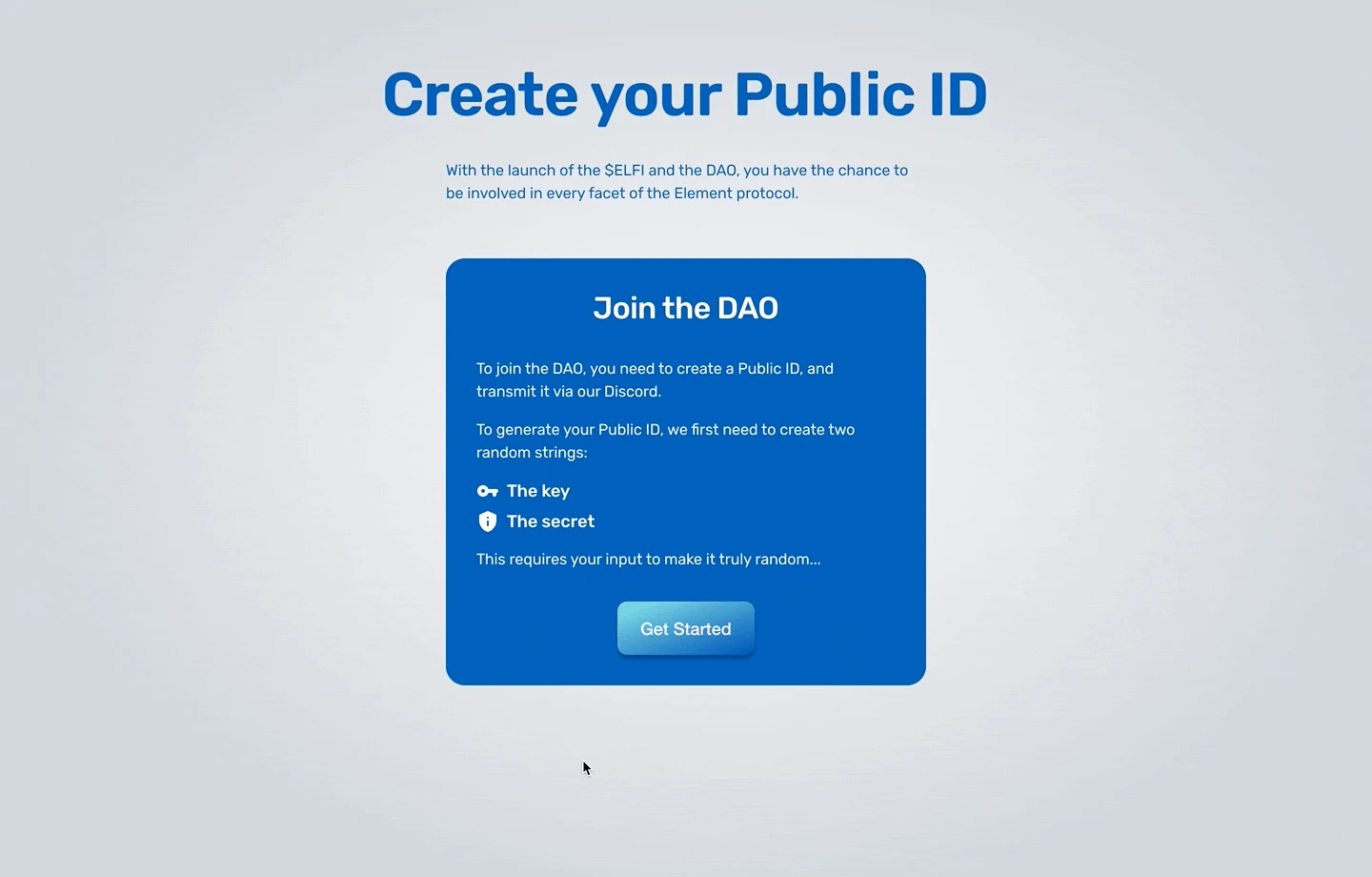
In the high-fidelity version I renamed the commitment a Public ID, a far friendlier name: something you create, post in Discord and unlock later. The key and the secret each got an icon, a stepper showed where you were, and a line on the first screen explained why your input was needed.
The two steps in high fidelity: create a Public ID, then unlock it to claim.
What shipped
Tina, Element’s designer, created the final version in Element’s style. It kept the slider, now with a progress bar, and the Public ID. It also added a JSON download for the key and secret, where my prototype had asked people to write them down, and a ready-made Discord command with a copy button.
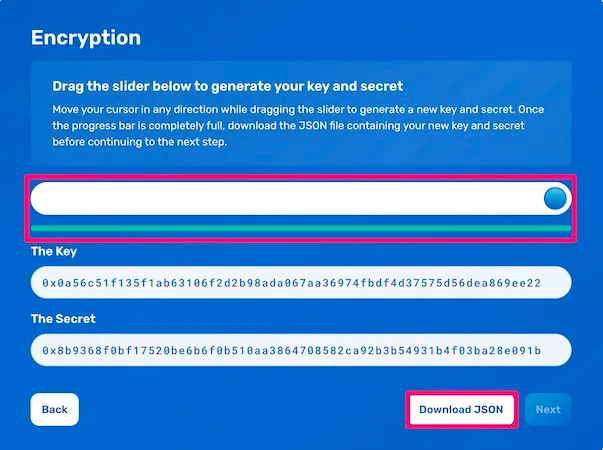
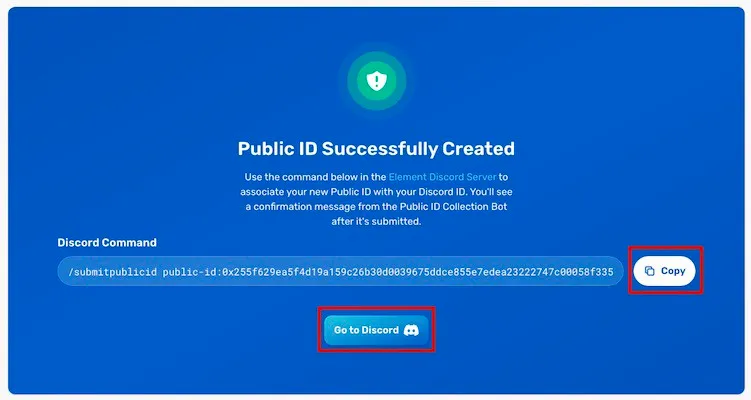
The final version, from Element’s documentation.
The airdrop ran in April 2022, and it worked.
Reflection
Tina has argued for more fun and personality in web3, and I agree. It is what pushed me to try something unusual for the random number generator rather than a plain input. The work was also a small example of how web3 teams operate: people in the UK, the US and Europe, from Element, a16z and Advanced Blockchain, agreed a new interface in a few calls with very little coordination.
A modern recreation: make your own random string
Recreated in 2026 Not the 2022 prototype, not Element’s code and not a real airdrop. Nothing you make here is stored or sent.
I really enjoyed this project, and I am still quietly proud of the idea. Privacy-preserving airdrops do not come along every week, so I may never get to design another. Rather than leave the slider trapped in a GIF, I have rebuilt it, so you too can know the joy of making 31 bytes of hand-crafted randomness.
No tokens will be awarded. Your Public ID will be valid nowhere and admired only by you.
Drag the slider and wiggle as you go: every change of direction goes into the numbers. Arrow keys work too, for the steady of hand.
The recreation needs JavaScript. The original 2022 prototype is shown above.
- Key
- Secret
- Public ID
Create the key
Drag the slider to the end. Every change of direction your pointer makes, and its exact timing, is mixed into the digits.
Movements mixed in: 00% generated
Your Public ID
In 2022, this is all you would have posted in Discord. It is a fingerprint of your key and secret that cannot be reversed. The key and secret were what you kept, to claim a week later.
Why the wiggling matters
- Private
Make two secrets
A random key and secret, created on your own device. Nobody else ever sees them.
- Public
Post a fingerprint
Your Public ID is a hash of the two: posted in Discord next to your name, but impossible to reverse.
- Public, reveals nothing
Prove, don't reveal
To claim, a zero-knowledge proof shows you know the key and secret behind one of the posted IDs, without saying which one.
- Public
Claim to a wallet
The tokens arrive in a wallet, and nothing on the record links that wallet back to your Discord name.
All of it rests on nobody else being able to work out your key and secret. A hand on a mouse never moves the same way twice, which makes it a surprisingly good source of secrets.